Practicing the CBSE Sample Papers for Class 10 Maths Basic Set 2 allows you to get rid of exam fear and be confident to appear for the exam.
CBSE Sample Papers for Class 10 Maths Basic Set 2 with Solutions
Time Allowed : 3 hours
Maximum Marks : 80
General Instructions:
- This Question Paper has 5 Sections A, B, C, D, and E.
- Section A has 20 Multiple Choice Questions (MCQs) carrying 1 mark each.
- Section B has 5 Short Answer-I (SA-I) type questions carrying 2 marks each.
- Section C has 6 Short Answer-II (SA-II) type questions carrying 3 marks each.
- Section D has 4 Long Answer (LA) type questions carrying 5 marks each.
- Section E has 3 Case Based integrated units of assessment (4 marks each) with sub-parts of the values of 1,1 and 2 marks each respectively.
- All Questions are compulsory. However, an internal choice in 2 Qs of 2 marks, 2 Qs of 3 marks and 2 Questions of 5 marks has been provided. An internal choice has been provided in the 2 marks questions of Section E.
- Draw neat figures wherever required. Take n = \(\frac{22}{7}\) wherever required if not stated.
Section – A
(Section A consists of 20 Questions of 1 marks each.)
Question 1.
If one of the zeroes of a quadratic polynomial of the form x² + ax + b is the negative of the other, then it
(A) has no linear term and the constant term is negative.
(B) has no linear term and the constant term is positive.
(C) can have a linear term but the constant term is negative.
(D) can have a linear term but the constant term is positive.
Answer:
(A) has no linear term and the constant term is negative.
Explanation :
Let f(x) = x² + ax + b and α, β are the roots of it.
Then, β = -α (Given)
α + β = \(\frac{-a}{1}\) and αβ = \(\frac{b}{1}\)
⇒ α – α = \(\frac{-a}{1}\) and α(-α) = \(\frac{b}{1}\)
-a = 0 and -α² = b
⇒ a = 0 and b < 0 or b is negative.
So, f(x) = x² + b shows that it has no linear term and constant term is negative
Question 2.
Which of the following equations has the sum of its roots as 3?
(A) 2x² – 3x + 6 = 0
(B) -x² + 3x – 3 = 0
(C) √2x² – \(\frac{3}{√2}\)x + 1 = 0
(D) 3x² – 3x + 3 = 0
Answer:
(B) -x² + 3x – 3 = 0
Explanation :
-x² + 3x – 3 = 0
On comparing with ax² +bx +c = 0
a = – 1,
b = 3,
c = -3
∴ Sum of the roots = \(\frac{-b}{a}\)
= \(\frac{-b}{-1}\) = 3
Question 3.
If 7 times the 7th term of an AP is equal to 11 times its 11th term, then its 18th term will be :
(A) 7
(B) 11
(C) 18
(D) 0
Answer:
(D) 0
Explanation :
According to question,
7t7 = 11t11
⇒ 7(a + 6d) = 11(a + 10d)
⇒ 4a + 68d = 0
⇒ 4(a + 17d) = 0
⇒ (a + 17d) = 0
⇒ t18 = 0
Question 4.
The distance between the points A (0, 6) and B (0, -2) is :
(A) 6
(B) 8
(C) 4
(D) 2
Answer:
(B) 8
Explanation : The distance between two points (x1, y1) and (x2, y2) is given as,
d = \(\sqrt{(x_2-x_1)^2 + (y_2-y_1)^2}\)
Where, x1 = 0, y1 = 6 and x2 = 0, y2 = -2
So, distance between A (0, 6) and B (0, -2) is
d = \(\sqrt{(0-0)^2 + (-2-6)^2}\)
= \(\sqrt{0^2 + (-8)^2}\)
= \(\sqrt{8^2}\)
= 8
Question 5.
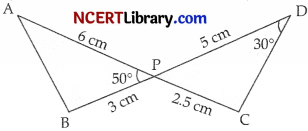
In the figure given below, two line segments AC and BD intersect each other at the point P such that PA = 6 cm, PB = 3 cm, PC = 2.5 cm, PD = 5 cm, ∠APB = 50° and ∠CDP = 30°. Then, ∠PBA is equal to :
(A) 50°
(B) 30°
(C) 60°
(D) 100°
Answer:
(D) 100°
Explanation :
In the given figure,
\(\frac{PA}{PB}=\frac{6}{3}=2\)
and
\(\frac{PD}{PC}=\frac{5}{2.5}=2\)
Thus \(\frac{PD}{PC}=\frac{PA}{PB}\) and ∠APB = ∠DPC
By SAS similarity, we get ∆APB ~ ∆DPC.
Hence, ∠PBA = 100°.
Question 6.
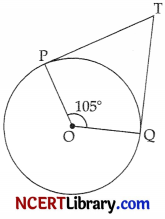
In the given figure, if TP and TQ are the two tangents to a circle with centre O so that ∠POQ = 105°, then ∠PTQ is equal to :
(A) 65°
(B) 75°
(C) 85°
(D) 95°
Answer:
(B) 75°
Explanation:
Given that, TP and TQ are tangents,
We know that the radius drawn to the tangents will be perpendicular.
∴ OP ⊥ TP
and OQ ⊥ TQ
∴ ∠OPT = 90°
∴ ∠OQT = 90°
In quadrilateral POQT,
Sum of all interior angles = 360°
∠OPT + ∠POQ + ∠OQT + ∠PTQ =360°
90° + 105° +90° + ∠PTQ = 360°
∠PTQ =75°.
Question 7.
X-axis divides the join of (2, -3) and (5, 6) in the ratio:
(A) 1:2
(B) 2:1
(C) 2:5
(D) 5:2
Answer:
(A) 1:2
Explanation:
Let P(x, 0) be a point on x-axis which divides the join of
A(2, -3) and B(5, 6) in the ratio m : n, then using section formula
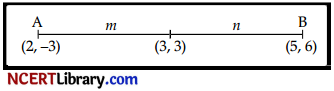
Y = \(\frac{my_2+ny_1}{m+n}\)
⇒ 0 = \(\frac{m(6)+n(-3)}{m+n}\)
⇒ 6m – 3n = 0
⇒ 2m – n = 0
⇒ 2m = n
⇒ \(\frac{m}{n}\) = \(\frac{1}{2}\)
i.e., m : n = 1 : 2
Question 8.
The empirical relation between mean, median and mode is:
(A) Mode = 3 Median – 2 Mean
(B) Mode = 3 Median + 2 Mean
(C) Mode = 2 Median – 3 Mean
(D) Mode = Median – 2 Mean
Answer:
(A) Mode = 3 Median – 2 Mean
Explanation:
Since,
Median = \(\frac{1}{3}\) mode + \(\frac{2}{3}\) mean
∴ Mode = 3 Median – 2 Mean
Question 9.
Pi () is _____ :
(A) Rational Number
(B) Integer
(C) Irrational Number
(D) None of these
Answer:
(C) Irrational Number
Explanation :
p is always an irrational number as it has non-terminating decimal expansion.
Question 10.
In the following frequency distribution, the median class is:
| Height (in cm) | 140 – 145 | 145 – 150 | 150 – 155 | 155 – 160 | 160 – 165 | 165 – 170 |
| Frequency | 5 | 15 | 25 | 30 | 15 | 10 |
(A) 145 – 150
(B) 150 – 155
(C) 155 – 160
(D) 160 – 165
Answer:
(C) 155 – 160
Explanation :
| Height | Frequency | c.f. |
| 140 – 145 | 5 | 5 |
| 145 – 150 | 15 | 20 |
| 150 – 155 | 25 | 45 |
| 155 – 160 | 30 | 75 |
| 160 – 165 | 15 | 90 |
| 165 – 170 | 10 | 100 |
N = 100
⇒ \(\frac{N}{2}\) = \(\frac{100}{2}\) = 50
The cumulative frequency just greater than 50 is
75 and the corresponding class is 155 – 160.
Hence, median class is 155 – 160.
Question 11.
Look at the numbers shown below.
(i) -0.5
(ii) 0.00001
(iii) \(\frac{1}{2}\)
(iv) 1
(v) 1.00001
(vi) 99%
Which of the above numbers represent probabilities of events?
(A) only (i) and (iii)
(B) only (i), (ii), (iii) and (iv)
(C) only (ii), (iii), (iv) and (v)
(D) only (ii), (iii), (iv) and (vi)
Answer:
(D) only (ii), (iii), (iv) and (vi)
Explanation:
Since, we know that the probability can neither be negative and nor be greater than one.
So, – 0.5 and 1.00001 can not represent probabilities of events.
Hence, only (ii), (iii), (iv) and (vi) represent probabilities of events.
Question 12.
Romy is blind folded and asked to pick one ball from each of the jars.
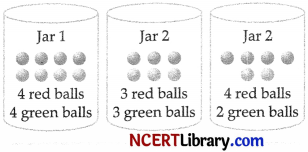
The chance of Romy picking a red ball is same in
(A) jars 2 and 3
(B) jars 1 and 3
(C) jars 1 and 2
(D) all the three jars
Answer:
(C) jars 1 and 2
Explanation:
For jar 1, probability picking a red ball = \(\frac{4}{8}=\frac{1}{2}\)
For jar 2, probability picking a red ball = \(\frac{3}{6}=\frac{1}{2}\)
For jar 3, probability picking a red ball = \(\frac{4}{6}=\frac{2}{3}\)
∴ Probability picking a red ball is same in jar 1 and 2.
Question 13.
The prime factors of 225 is:
(A) 3² × 5²
(B) 3 × 5³
(C) 3³ × 5
(D) 3³ × 5³
Answer:
(A) 3² × 5²
Explanation:
By prime factorization of 225,
we get 225 = 3 × 3 × 5 × 5
= 3² × 5² or 5² × 3²
Question 14.
AOBC is a rectangle whose three vertices are vertices A (0, 3), O (0, 0) and B (5, 0). The length of its diagonal is:
(A) 5 units
(B) 3 units
(C) √34 units
(D) 4 units
Answer:
(C) √34 units
Explanation:
According to the question, a triangle can be represented as:
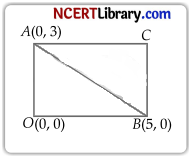
∴ Distance between the points A (0, 3) and B (5, 0) is
AB = |\(\sqrt{(5-0)^2 + (0-3)^2}\)|
= |\(\sqrt{25 + 9}\)|
= \(\sqrt{34}\) units
Hence, the required length of diagonal is √34 units.
Question 15.
Given that sec θ = √2, the value of \(\frac{1+tan θ}{sin θ}\) is :
(A) 2√2
(B) √2
(C) 3 √2
(D) 2
Answer:
(A) 2√2
Explanation:
It is given that
sec θ = 2 …(i)
Also, sec θ = sin 45° …(ii)
From (i) and (ii), we get
θ = 45°
Put value of θ in \(\frac{1+tan θ}{sin θ}\), we get
\(=\frac{1+\tan 45^{\circ}}{\sin 45^{\circ}}\)
\(=\frac{1+1}{\frac{1}{\sqrt{2}}}\)
\(=2 \sqrt{2}\)
Question 16.
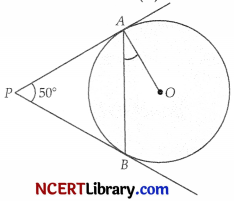
In figure, PA and PB are tangents to the circle with centre O such that ∠APB = 50°. The measure of ∠OAB is:
(A) 25°
(B) 30°
(C) 50°
(D) 45°
Answer:
(A) 25°
Explanation:
Here, ∠APB = 50°
∠PAB = ∠PBA = \(\frac{180°-50°}{2}\) = 65°
∠OAB = 90° – ∠PAB
= 90° – 65° = 25°
Question 17.
If sec θ sin θ = 0, then the value of θ is:
(A) 30°
(B) 45°
(C) 0°
(D) 90°
Answer:
(C) 0°
Explanation:
Given, sec θ.sin θ = 0
or, \(\frac{sin θ}{cos θ}=0\)
or, tan θ = 0 = tan 0°
∴ θ = 0°
Question 18.
If sin θ + cos θ = √2 cos θ, (θ 90°) then find the value of tan θ is:
(A) √3 – 1
(B)√3
(C) √2
(D) √2 – 1
Answer:
(D) √2 – 1
Explanation:
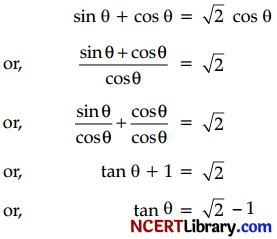
Directions for Questions 19 and 20: In the following questions, A statement of Assertion (A) is followed by a statement of Reason (R). Choose the correct option.
(A) Both (A) and (R) are true and (R) is the correct explanation of (A).
(B) Both (A) and (R) are true but (R) is NOT the correct explanation of (A).
(C) (A) is true but (R) is false,
(D) (A) is false and (R) is true.
Question 19.
Assertion (A): If k + 1 = sec² θ (1 + sin θ) (1 – sin θ), then the value of k is 1.
Reason (R): If sin θ + cos θ = √3, then the value of tan θ + cot θ is 1.
Answer:
(D) (A) is false and (R) is true.
Explanation:
In case of assertion:
k + 1 = sec² θ(1 + sin θ)(1 – sin θ)
or, k + 1 = sec2 θ(1 – sin2 θ)
or, k + 1 = sec² θ.cos2 θ
[ Q sin² θ + cos² θ = 1]
or, k + 1 = sec² θ × \(\frac{1}{sec² θ}\)
or, k + 1 = 1
or, k = 1 – 1
∴ k = 0
∴ Assertion is incorrect.
In case of reason:
Given sin θ + cos θ = √3
Squaring on both sides,
(sin θ + cos θ)² = (√3)²
sin² θ + cos² θ + 2 sin θ cos θ = 3
1 + 2 sin θ cos θ = 3
2 sin θ cos θ = 2
sin θ cos θ = 1 … (i)
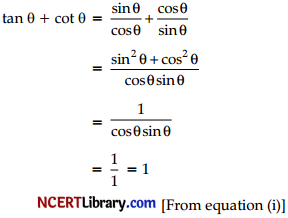
∴ Reason is correct.
Hence, Assertion is incorrect but reason is correct.
Question 20.
Assertion (A): In a right circular cone, the cross-section made by a plane parallel to the base is a circle.
Reason (R): If the volume and the surface area of a solid hemisphere are numerically equal, then the diameter of hemisphere is 9 units.
Answer:
Option (B) is correct.
Explanation: In case of assertion:
In a right circular cone, if any cut is made parallel
to its base, we get a circle.
∴ Assertion is correct.
In case of reason:
Let radius of sphere be r.
Given, volume of hemisphere = Surface area of
hemisphere
or, \(\frac{2}{3}\)πr³ = 3πr²
or, r = \(\frac{9}{2}\) units
∴ Diameter = \(\frac{9}{2}\) × 2 = 9 units
∴ Reason is correct:
Hence, both assertion and reason are correct but
reason is not the correct explanation for assertion.
Section – B
Section B consists of 5 Questions of 2 marks each.
Question 21.
In the AABC, D and E are points on side AB and AC respectively such that DE || BC. If AE = 2 cm, AD = 3 cm and BD = 4.5 cm, then find CE.
Answer:
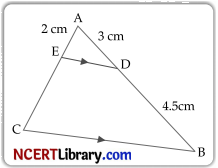
Using basic proportionality theorem
\(\frac{AD}{BD}=\frac{AE}{CE}\) [By using BPT]
\(\frac{2}{4.5}=\frac{2}{CE}\)
CE = 3 cm
Question 22.
If a and p are the zeroes of a polynomial x²- 4√3x + 3, then find the value of α + β – αβ.
OR
For what value of k, 2x + 3y = 4 and (k + 2)x + 6y = 3k + 2 will have infinitely many solutions ?
Answer:
Let, x² – 4√3x + 3 = 0
If α and β are the zeroes of x² – 4 3x + 3.
then α + β = \(\frac{-b}{a}\)
⇒ α + β = \(\frac{-4√3}{1}\)
⇒ α + β = 4√3
and αβ = \(\frac{c}{a}\)
⇒ αβ = \(\frac{3}{1}\)
⇒ αβ = 3
⇒ α + β – αβ = 4√3 – 3
OR
We have, for the equation 2x + 3y – 4 = 0
a1 = 2, b1 = 3 and c1 = – 4
and for the equation (k + 2) x + 6y – (3k + 2) = 0
a2 = k + 2, b2 = 6 and c2 = – (3k + 2)
For infinitely many solutions,
\(\frac{a_1}{a_2}=\frac{b_1}{b_2}=\frac{c_1}{c_2}\)
⇒ \(\frac{2}{k+2}=\frac{3}{6}=\frac{-4}{-(3k+2)}\)
⇒ 3(k + 2) = 2 × 6
or, 3k + 6 = 12
or, 3k + 2 = 8
⇒ 6 = 3k
or, 3k = 6
Hence, k = 2
Question 23.
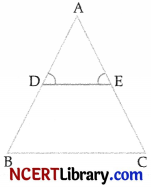
In the adjoining figure,
∠D = ∠E and \(\frac{AD}{DB}=\frac{AE}{EC}\),
Prove that ABAC is an isosceles triangle.
Answer:
Given: ∠D = ∠E and \(\frac{AD}{DB}=\frac{AE}{EC}\).
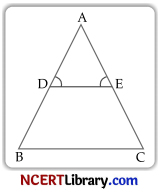
To prove: ∆BAC is an isosceles triangle.
Proof: \(\frac{AD}{DB}=\frac{AE}{EC}\)
By converse of BPT,
DE || BC
∴ ∠ADE = ∠ABC
(Corresponding angles)
And ∠AED = ∠ACB
(Corresponding angles)
∵ ∠ADE = ∠AED (Given)
∴ ∠ABC = ∠ACB ⇒ AB = AC
So, BAC is an isosceles triangle.
Hence Proved.
Question 24.
Two dice are thrown at the same time and the product of numbers appearing on them is noted. Find the probability that the product is a prime number.
OR
Five cards, ten, Jack, Queen, King and Ace of diamond are well shuffled. One card is picked up from them.
(i) Find the probability that the drawn card is Queen.
(ii) If Queen is put aside, then find the probability that the second card drawn is an ace.
Answer:
Total number of outcomes = 36
Favourable outcomes are (1, 2), (2, 1), (1, 3), (3, 1), (1, 5), (5, 1) i.e., 6
Required probability = \(\frac{6}{36} or \frac{1}{6}\)
OR
Total cards = 5
(i) P(Queen) = \(\frac{1}{5}\)
(ii) P(Ace) = \(\frac{1}{4}\)
(Since, Queen was kept aside 5 – 1 = 4)
Question 25.
An observer 1.5 metres tall is 20.5 metres away from a tower 22 metres high. Determine the angle of elevation of the top of the tower from the eye of the observer.
Answer:
Let AB be the observer and TW be the tower.
In ΔAMT
tan θ = \(\frac{20.5}{20.5}=1\)
tan θ = tan 45°
⇒ θ = 45°
Hence, the required angle of elevation of the top of the tower from the eye of the observer is 45°.
Section – C
Section C consists of 6 Questions of 3 marks each.
Question 26.
How many two digit numbers are divisible by 7 ?
OR
Find the 25th term of the A.E – 5, \(\frac{-5}{2}\), 0, \(\frac{5}{2}\), ……….. .
Answer:
Two digit numbers which are divisible by 7 are 14, 21, 28, ……, 98.
It forms an A.P.
Here, a = 14, d = 7 and an = 98
Since, an = a + (n – 1)d
98 = 14 + (n – 1)7
98 – 14 = 7n – 7
84 + 7 = 7n
or, 7n = 91
or, n = 13
OR
Here, a= \(\frac{-5}{2}\) and d = \(– \frac{5}{2}\)-(-5) = \(\frac{5}{2}\)
Since, nth term = a + (n – 1)d
Then, 25th term = – 5 + (25 – 1) × \(\frac{5}{2}\)
= – 5 + 60
= 55
Question 27.
The sum of first n terms of three arithmetic progressions are S1, S2 and S3 respectively. The first term of each A.E is 1 and common differences are 1,2 and 3 respectively. Prove that S1 + S3 = 2S2
OR
Three consecutive natural numbers are such that the square of the middle number exceeds the difference of the squares of the other two by 60. Find the numbers.
Answer:
Since, S1 = 1 + 2 + 3 + …. + n.
S2 = 1 + 3 + 5 + …upto n terms
and S3 = 1 + 4 + 7 + …upto n terms
or, S1 = \(\frac{n(n+1)}{2}\)
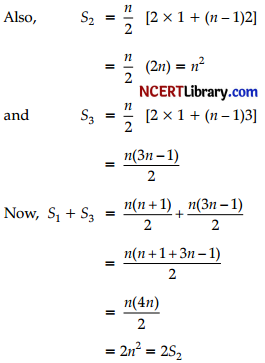
Hence Proved.
OR
Let the three consecutive natural numbers be x, x + 1 and x + 2.
∴ (x + 1)² = (x + 2)² – (x)² + 60
⇒ x² + 2x + 1 = x² + 4x + 4 – x² + 60
⇒ x² – 2x – 63 = 0
⇒ x² – 9x + 7x – 63 = 0
⇒ x (x – 9) + 7 (x – 9) = 0
⇒ (x – 9)(x + 7) = 0
Thus, x = 9 or x = – 7
Rejecting – 7, we get
x = 9
Hence, three numbers are 9, 10 and 11.
Question 28.
If the mid-point of the line segment joining A[latex]\frac{x}{2}, \frac{y+1}{2}[/latex] and B(x + 1, y-3) is C(5, -2), find x and y.
Answer:
At mid-point of AB = [\(\frac{\frac{x}{2}+x+1}{2}\) = 5and
[\(\frac{\frac{y+1}{2}+y-3}{2}\) = -2
or, x = 6 and y + 1 + 2y – 6 = – 8
or, x = 6 and y = – 1.
Question 29.
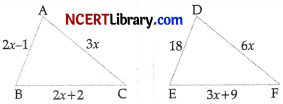
In the given figure, if ∆ABC ~ ∆EF and their sides of the given figure lengths (in cm) are marked along them, then find the value of x.
Answer:
Given, ∆ABC ~ ∆DEF
Then according to question,
\(\frac{AB}{DE}=\frac{BE}{EF}\) [From BPT]
⇒ \(\frac{2x-1}{18}=\frac{2x+2}{3x+9}\)
⇒ (2x – 1)(3x + 9) = 18(2x + 2)
⇒ (2x – 1)(x + 3) = 6(2x + 2)
⇒ 2×2 – x + 6x – 3 = 12x + 12
⇒ 2×2 + 5x – 12x – 15 = 0
⇒ 2×2 – 7x – 15 = 0
⇒ 2×2 – 10x + 3x – 15 = 0
⇒ 2x(x – 5) + 3(x – 5) = 0
⇒ (x – 5)(2x + 3) = 0
Either x = 5 or x = \(\frac{-3}{2}\), which is not possible
So, x = 5
Then in ∆ABC, we have
AB = 2x – 1 = 2 × 5 – 1 = 9
BC = 2x + 2 = 2 × 5 + 2 = 12
AC = 3x = 3 × 5 = 15
and in ∆DEF, we have
DE = 18
EF = 3x + 9 = 3 × 5 + 9 = 24
DE = 6x = 6 × 5 = 30
Question 30.
From the top of a 7 m high building, the angle of elevation of the top of a tower is 600 and the angle of depression of its foot is 45°. Find the height of the tower. (Use \(\sqrt{3}\) = 1.732)
Answer:
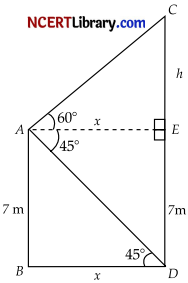
In ∆ABC, ∆CBD = ∆ECB = 45°
(alternate angles)
∴ \(\frac{CD}{BD}\) = tan 45°
\(\frac{7}{x}=1\)
x = 7
In ∆AEC, \(\frac{AE}{CE}\) = tan 60°
⇒ \(\frac{h-7}{x}\) = \(\sqrt{3}\)
⇒ h – 7 = x \(\sqrt{3}\)
⇒ h – 7 = 7 \(\sqrt{3}\)
⇒ h = 7 \(\sqrt{3}\) + 7
= 7 (\(\sqrt{3}\)+1)
= 7(1.732 + 1)
Hence, height of tower = 19.124 m.
Question 31.
Evaluate : 4 (sin4 30° + cos4 60°) -3(cos2 45°- sin2 90°)
Answer:
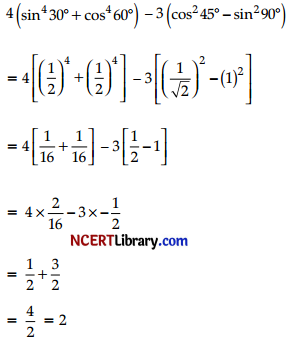
Section – D
Section D consists of 4 Questions of 5 marks each.
Question 32.
The present age of the father is twice the sum of the ages of his 2 children. After 20 years, his age will be equal to the sum of the ages of his children. Find the age of the father.
OR
If the sum of first m terms of an A.E is same as the sum of its first n terms (m ≠ n), show that the sum of its first (m + n) terms is zero.
Answer:
Let the sum of the ages of the 2 children be x and the age of the father be y years.
∴ y = 2x
2x – y = 0 …(i)
and 20 + y = x + 40
x – y = – 20 …(ii)
Subtracting (ii) from (i),
x = 20 1
From (i), y = 2x ⇒ 2 × 20 = 40
y = 40
Hence, the age of the father = 40 years.
OR
Let 1st term of series be a, common difference be d, then
Sm = Sn
or, m2
[2a m+( – 1) ]d = \(\frac{n}{2}\) [2a n+(-1)]d
or, 2a(m – n) + {(m² – n²) – (m – n)}d = 0
or, 2a(m – n) + {(m – n)(m + n) – (m – n)}d = 0
or, (m – n)[2a + (m + n – 1)d] = 0
or, 2a + (m + n – 1)d = 0, [∵ m – n ≠ 0]
∴ Sm+n = \(\frac{m+n}{2}\) [2a + (m + n – 1)d]
= \(\frac{m+n}{2}\) × 0 = 0
Hence Proved.
Question 33.
Prove that the lengths of two tangents drawn from an external point to a circle are equal.
OR
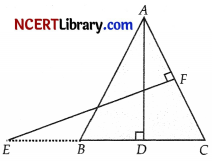
In the given figure, AB = AC. E is a point on CB produced. If AD is perpendicular to BC and EF perpendicular to AC. Prove that ∆ABD is similar to ∆CEE.
Answer:
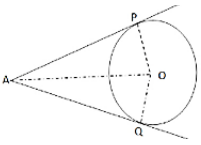
Given : C(0,r) 2 tangents from P at A and B
To Prove : AP = BP
Construction: Join OA, OB and OP.
In ∆APO and ∆BPO
OA = OB radii of same circle
OP = OP comman side
∠OAP = ∠OBP = 90° – radius is ⊥ tangent at point of contact by RHS
Lengths of 2 tangents drawn from an external point of a circle are equal.
OR
OR
In ∆ABD and ∆CEF, given
AB = AC
Then, ∠ABC = ∠ACB
or ∠ABD = ∠ECF
∠ADB = ∠EFC (each 90°)
∴ DABD ~ DECF (AA Similarity)
Hence Proved.
Question 34.
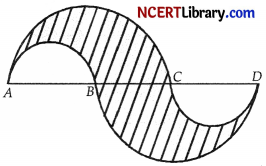
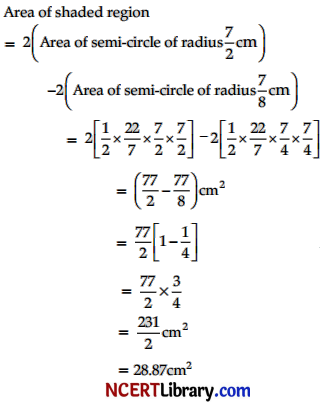
In figure, AC = BD = 7 an and AB = CD = 1.75 cm. Semi-cirdes are drawn as shown in the figure. Find the area of the shaded region. [Use π = \(\frac{22}{7}\)]
Answer:
Question 35.
The following table shows the age distribution of cases of a certain disease admitted during a year in a particular hospital:
| Class | 5-14 | 15-24 | 25-34 | 35-44 | 45-54 | 55-64 |
| Frequency | 6 | 11 | 21 | 23 | 14 | 5 |
(i) Find the average age toivhich maximum cases occurred.
(ii) Which mathematical concept is used in this problem?
Answer:
(i) Here class intervals are not in inclusive form.
So, we first convert them in inclusive form by subtracting 0.5 from the lower limit and adding 0.5 to the upper limit of each cases, where h is the difference between the lower limit of a class and the upper limit of the preceding class.
The given frequency distribution in inclusive form is as follows :
| Age (in years) | Frequency |
| 4.5-14.5 | 6 |
| 14.5- 24.5 | 11 |
| 24.5- 34.5 | 21 |
| 34.5- 44.5 | 23 |
| 44.5- 54.5 | 14 |
| 54.5- 64.5 | 5 |
Since highest frequency is 23 so, the modal class is 34.5 – 44.5.
Now,
\(\text { Mode }=l+\left[\frac{f_1-f_0}{2 f_1-f_0-f_2}\right] h\)
Here, l = 34.5, h = 10, f1 = 23, f0 = 21, f2 = 14
⇒ Mode = \(\frac{23-21}{46-21-14}\) × 10
= 34.5 + \(\frac{2}{11}\) × 10
= 34.5 + 1.31
= 36.31 is the average age.
(ii) Mode of grouped data.
Section – E
Case study based questions are compulsory.
Question 36.
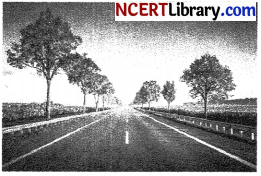
Raj and Ajay are very close friends. Both the families decide to go to Ranikhet by their own cars. Raj’s car travels at a speed of x km/h while Ajay’s car travels 5 km/h faster than Raj’s car. Raj took 4 hours more than Ajay to complete the journey of 400 km.
I. What will be the distance covered by Ajay’s car in two hours?
II. What is the speed of Raj’s car?
III. How much time took Ajay to travel 400 km?
OR
Find the positive root of x² – 7x -144 = 0
Answer:
I. Let the speed of Ajay’s car be (x + 5) km/h
Distancecovered by Ajay’s car in two hours = 2(x+ 5) km.
II. On solving the quadratic equation,
x² + 5x – 500 = 0
We get, x = 20 and – 25(rejected)
So the speed of Raj’s car is 20 km/hour.
III. We have Speed of Ajay’s
car = x + 5 = 25 km/h
Time taken by Ajay = \(\frac{400}{25}\) = 16 hours
OR
x² – 7x – 144 = 0
∴ x² – 16x + 9x – 144 = 0
⇒x (x – 16) + 9 (x – 16) = 0
⇒ (x – 16) (x + 9) = 0
Ether x = 16 or x = – 9
But positive root is 16.
Question 37.
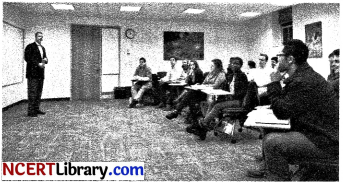
A seminar is being conducted by an Educational Organisation, where the participants will be educators of different subjects. The number of participants in Hindi, English and Mathematics are 60,84 and 108 respectively.
I. In each room the same number of participants are to be seated and all of them being in the same subject, hence
find maximum number participants that can accommodated in each room.
OR
What is the minimum number of rooms required during the event?
II. Find the LCM of 60,84 and 108.
III. Find the prime factorisation of 108.
Answer:
I. No. of participants seated in each room would be HCF of all the three values above.
60 = 2 × 2 × 3 × 5
84 = 2 × 2 × 3 × 7
108 = 2 × 2 × 3 × 3 × 3
Hence, HCF = 12. 2
OR
Minimum no. of rooms required are total number of students divided by number of students in each room.
No. of rooms = \(\frac{60+84+108}{12}\) = 21
II. From part (i), we get
LCM = 2 × 2 × 3 × 3 × 3 × 5 × 7 = 3780.
III. From part (i), we get
Prime factors of 108 = 2 × 2 × 3 × 3 × 3 = 22 × 33.
Question 38.
In a workshop, brooch is made with silver wire in the form of a circle with diameter 35 mm. The wire is also used in making 5 diameters which divide the circle into 10 equal sectors as shown in the given figure.

What is the radius of the circle?
What is the circumference of the brooch?
III. What is the total length of silver wire required?
OR
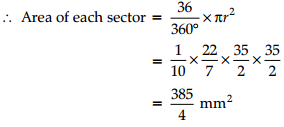
What is the area of the each sector of the brooch?
Answer:
I. Radius of circle = \(\frac{\text { Diameter }}{2}\)
= \(\frac{35}{2}\) mm
II. Circumference of brooch = 2πr
= 2 × \(\frac{22}{7}\) × \(\frac{35}{2}\)
= 110 mm
III. Length of wire required
= 110 + 5 × 35
= 110 + 175
= 285 mm.
OR
It can be observed from the figure that an angle
of each 10 sectors of the circle is subtending at the
centre of the circle.